

You see that shockproof silicone foam gives great cushioning. Its special cellular structure makes small air pockets. These pockets help cushion things when they get hit. The inorganic polymer backbone makes the foam strong. This backbone helps the foam take in force. It gives steady cushioning and keeps important parts safe. When you test the foam, it keeps its shape after many uses. Even in tough conditions, it still cushions well. This makes it a good pick for hard jobs. You trust its cushioning to keep things safe and last long.
Cellular Structure
Open-Cell vs. Closed-Cell
Shockproof silicone foam has two main cell types. One is open-cell, and the other is closed-cell. Open-cell silicone foam has tiny holes that connect. These holes let air and sound pass through the foam. This helps the foam cushion and absorb sound or shaking. Open-cell foam works best with sounds in the middle range, like 1000–2000 Hz. The open holes help turn sound into heat. This makes the foam better at soaking up energy. The foam can also stop shaking and soften hits.
Closed-cell silicone foam has sealed holes that do not connect. These holes trap air inside and stop air from moving. This gives the foam strong cushioning and helps it spring back after a hit. Closed-cell foam bounces back and blocks high sounds. It does not soak up sound as well as open-cell foam. But it is great for stopping hard hits. You can pick the type you need for the best cushioning and energy absorption.
|
Structure Type |
Pore Connection |
Best Use |
Cushioning Effectiveness |
|---|---|---|---|
|
Open-Cell |
Connected |
Sound/vibration absorption |
High (middle frequencies) |
|
Closed-Cell |
Isolated |
Impact protection |
High (impact, less for sound) |
Energy Dissipation
The way silicone foam is built helps it handle force. When you press or hit the foam, the cells squish. This lets the foam take in and spread out the force. The foam does not break or lose its shape easily. It takes in energy and lets it out slowly. This makes it good at soaking up energy.
The size and shape of the cells matter a lot. Smaller cells make the foam stronger and better at stopping shocks. If the foam has layers of different cell sizes, it cushions even better. The foam can take more force and protect what is inside. Special designs, like layered cells, help the foam soak up more energy.
Tip: If you pick silicone foam with small or layered cells, you get better cushioning and energy absorption. This helps keep your things safe.
New ways, like supercritical fluid foaming, help control cell size and shape. These new methods let you change how the foam cushions and soaks up energy. By picking the right cell structure, you get the best protection from shocks and hits.
Material Properties
Inorganic Polymer Backbone
Shockproof silicone foam is strong because of its silicon-oxygen backbone. This backbone is the main part of the foam. The Si-O bonds are much stronger than C-C bonds. These strong bonds help the foam stay in shape and keep its strength. The foam works well even in tough places. The backbone also helps the foam handle heat and chemicals. You can use the foam where there is heat, water, or chemicals. It will still protect your devices with good cushioning.
The silicon-oxygen backbone stops the foam from breaking down fast. The foam keeps its strength after many uses. Methyl groups on the backbone make the foam resist water. They also help the foam last longer. This means you can trust the foam in electronics, fireproof seals, and nuclear power plants.
|
Property/Aspect |
Description/Value |
|---|---|
|
Polymer Backbone |
Inorganic silicon-oxygen (Si-O) bonds |
|
Si-O Bond Energy |
121 kcal/g molecule |
|
C-C Bond Energy |
82.6 kcal/g molecule |
|
Thermal Stability |
High due to strong Si-O bonds; bonds do not break easily at high temperatures or radiation exposure |
|
Chemical Resistance |
Resistant to UV light and ozone due to absence of double bonds in backbone |
|
Weather Resistance |
Excellent, with service life in natural environment up to several decades |
|
Foam Silicone Properties |
High thermal stability, moisture resistance, shock resistance, and flame retardancy |
|
Application Examples |
Fireproof sealing, electronic component protection, nuclear power plants, offshore oil equipment |
You can see how the backbone changes the foam's strength. The table below shows how the structure affects stretching and strength. If you use foam with solid layers, it gets stronger and cushions better.
|
Sample Type |
Tensile Strength (MPa) |
Elongation at Break (%) |
Key Influence Factors |
|---|---|---|---|
|
Pure solid silicone rubber (S1) |
8.91 |
N/A |
Baseline solid material |
|
Pure silicone rubber foam (S3, S4) |
3.69, 3.52 |
N/A |
Lower tensile strength due to foam cellular structure |
|
Foam/solid alternating multilayer (S6, S7) |
5.39, 5.09 |
585.91, 696.06 |
Improved tensile strength and elongation due to solid layers enhancing structural integrity |
|
Effect of saturation pressure increase |
3.88 to 5.25 |
416.09 to 699.28 |
Higher pressure reduces cell size, improving mechanical properties |
|
Effect of saturation temperature increase |
5.34 to 4.01 |
789.22 to 536.16 |
Higher temperature increases cell size, reducing mechanical properties |
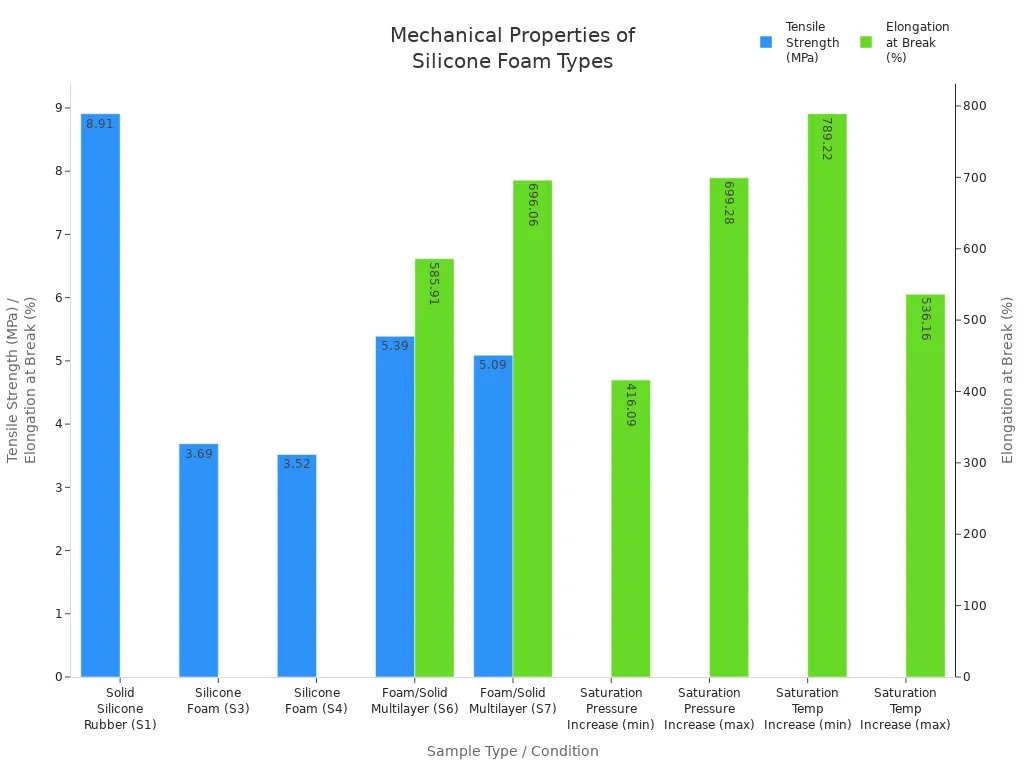
Note: The silicon-oxygen backbone lets you use silicone foam where other materials would not work. You get strong foam that lasts a long time.
Viscoelasticity
Viscoelasticity gives silicone foam its special cushioning. When you press the foam, it bends and stretches. The foam takes in the force and spreads it out. This keeps things inside safe. The foam slowly goes back to its old shape. You see this in shoes, helmets, or electronics.
The foam can handle both fast and slow forces. It can stretch far without breaking. The foam's cell structure and density change how it cushions. Foam with more density soaks up more energy and is stronger. Open-cell foam can bend more, so it cushions better for many hits.
The foam cushions both light and hard impacts.
Viscoelasticity helps the foam bounce back after use.
You can trust the foam to protect things for a long time.
Tip: For the best cushioning, pick silicone foam with the right density and cell structure.
Compression Set Resistance
Compression set resistance shows how well the foam bounces back after being squeezed. You want low compression set for the best cushioning. If the foam does not bounce back, it loses its power. Silicone foam bounces back better than many other materials.
You can make compression set resistance better by adding special inhibitors. CSI-018 helps the foam recover faster and keeps its shape longer. Foam with CSI-018 has a compression set of only 15%. Foam without it has 34%. The foam also soaks up more energy and recovers in just 18 seconds. This means you get better cushioning for a longer time.
|
Parameter |
PORON® Urethanes (Polyurethane Foam) |
BISCO® Silicones (Silicone Foam) |
ARLON® Industrial (Silicone Sponge) |
|---|---|---|---|
|
Compression Set Method |
ASTM D3574 |
ASTM D1056 Class 1D |
ASTM D1056 Class 2D |
|
Cell Structure |
Open |
Modified Open/Closed |
Closed |
|
Sample Minimum Thickness |
0.375" |
0.250" |
0.500" |
|
Test Compression Amount |
50% |
50% |
50% |
|
Test Time |
22 hours ± 30 minutes |
22 hours ± 30 minutes |
22 hours ± 30 minutes |
|
Test Temperature |
70 °C |
100 °C |
100 °C |
|
Recovery Time After Load Release |
30 ± 5 minutes |
30 ± 5 minutes |
24 hours ± 15 minutes |
|
Compression Set Calculation |
[(to - tl) / to] x 100 |
[(to - tl) / (to - ts)] x 100 |
[(to - tl) / (to - ts)] x 100 |
You test compression set using ASTM methods. You squeeze the foam to half its thickness for 22 hours at high heat. After you let go, you see how much the foam bounces back. Lower numbers mean better resistance. Silicone foam often does better than other materials. You get good cushioning even after many uses.
Note: In real life, compression set inhibitors help your foam last longer. You see less seat sagging in cars or worn-out pads in safety gear. This means you get good cushioning for many years.
Energy Absorption
Absorption Mechanism
Shockproof silicone foam absorbs energy very well. The foam has tiny cells that act like springs and cushions. When something hits the foam, the cells bend and stretch. Sometimes, the cells break. This helps the foam soak up force and spread it out. The foam protects what is inside by cushioning it.
- The cell walls bend or break to absorb energy.
- The foam stretches and goes back to its shape. This gives steady cushioning.
- Fillers like sand or graphite make the foam stronger. These fillers help the foam handle more force.
- Open-cell or partly open-cell foam can change shape. This lets the foam absorb more energy.
- When hit hard, the cell walls get thin and join together. This changes the cell size and keeps the foam working well.
- You can trust shockproof silicone foam to protect things. The foam's stiffness and damping work together for top protection. The foam keeps cushioning well, even after many hits.
- Note: The foam's cell changes, viscoelastic energy loss, and fillers give great cushioning and energy absorption.
Quantifying Efficiency
You can measure how well the foam absorbs energy by looking at its stress-strain curve. This curve shows what happens when you squeeze or stretch the foam. There are three main parts of the curve:
Linear Elastic Region: The foam stretches or squeezes in a straight line. It acts like a spring and gives soft cushioning.
Plateau Region: The foam's cells start to collapse. The foam soaks up lots of energy here. This is where cushioning is best.
Densification Region: The cells are all collapsed. The foam gets harder and cannot absorb much more energy.
The area under the curve tells you how much energy the foam absorbs. A bigger area means better cushioning. The foam's stiffness and damping also show how well it stores and loses energy. Fillers inside the foam make these numbers higher, so the foam cushions even better.
|
Region |
What Happens |
Cushioning Effectiveness |
Mechanical Properties Involved |
|---|---|---|---|
|
Linear Elastic |
Foam stretches or squeezes evenly |
Low to moderate |
Stiffness, elasticity |
|
Plateau |
Cells collapse and absorb energy |
High |
Damping, viscoelasticity |
|
Densification |
Foam gets harder, less absorption |
Low |
More stiffness |
Tip: When you pick foam, look at the stress-strain curve and mechanical properties. This helps you choose foam with the best cushioning and energy absorption.
Shockproof silicone foam stands out because it cushions well, has strong mechanical properties, and absorbs energy reliably. The foam's design and materials work together to protect your things every time.
Shockproof Silicone Foam vs. Other Material
Comparative Performance
You want your devices to be safe. Different materials protect things in different ways. Shockproof silicone foam is special. It cushions well and keeps its shape after many hits. You can count on it to guard your stuff from drops.
Let's look at some common materials:
|
Material |
Cushioning |
Mechanical Properties |
Durability & Reliability |
Notes |
|---|---|---|---|---|
|
Silicone Foam |
Very high |
Flexible, resilient, good under stress |
Durable, but not as long-lasting as metal |
Lightweight, flexible |
|
Polyurethane Foam |
High (depends on density) |
Good, but can break down over time |
Cost-effective, but may lose shape |
Easy to mold |
|
EVA |
Good |
Flexible, less dense |
Water-resistant, good for outdoors |
Lightweight |
|
Rubber |
Moderate |
Strong, but heavy |
Can crack or harden |
Good grip, but less soft |
|
Metal |
Low |
Very strong, rigid |
Lasts a long time |
Heavy, not soft |
|
Plastic |
Low to moderate |
Varies by type |
Can scratch or wear |
Cheap, light |
Shockproof silicone foam gives the best cushioning. It also has strong mechanical properties. Polyurethane and EVA cushion well, but may not last as long. Rubber is tough, but not very soft. Metal and plastic are hard and strong. They do not absorb shocks well.
Note: If you want great cushioning and strength, shockproof silicone foam is a smart pick.
Limitations
Think about cost and the environment too. Shockproof silicone foam costs more than polyurethane or EVA. Making it is harder. You pay more, but get better protection.
Silicone foam does not break down quickly. It lasts longer than rubber or some plastics. If you want something that breaks down fast, silicone foam may not be best. Polyurethane and EVA are cheaper. They do not cushion or protect as well.
Silicone foam: Costs more, cushions well, strong, lasts long.
Polyurethane/EVA: Cheaper, cushions okay, not as tough, easier to recycle.
Rubber: Heavy, can crack, not very soft.
Metal/Plastic: Hard, not soft, but very strong.
You need to balance cost, performance, and the environment. If you want top cushioning and strength, shockproof silicone foam is worth it, even if it costs more.
Applications
Electronics Protection
Shockproof silicone foam helps keep electronics safe. It cushions things like phones, tablets, and smartwatches. Silicone straps on watches feel soft and stop your wrist from getting tired. Water-resistant phones use silicone gaskets to block water from getting inside. Foam inserts and boxes protect electronics when you ship or store them. Padding made of foam soaks up bumps and shakes. This keeps tiny parts from breaking. Anti-static foam stops static electricity from hurting inside parts. Silicone foam stays soft and keeps its shape after many uses. This helps your devices last longer.
Tip: Pick silicone foam for electronics if you want good protection from heat, water, and bumps.
|
Application Area |
Example Product |
Practical Benefit |
|---|---|---|
|
Wearable Electronics |
Galaxy Watch straps |
Comfort, durability, less tired wrist |
|
Smartphones |
iPhone gaskets |
Stops water, protects ports |
|
Battery Systems |
Tesla Powerwall |
Keeps heat and weather out |
|
Storage/Transport |
Foam inserts, lined boxes |
Holds items tight, stops damage |

Automotive and Aerospace
Cars and airplanes use shockproof silicone foam in many places. In cars, foam cushions engine mounts, seats, and door seals. Engine mounts with foam cut down on shaking and noise. This makes rides smoother and helps engines last longer. Door and window seals use foam to keep out water, dust, and noise. Car seats have foam for better support and comfort. This helps drivers feel less tired. In planes, foam is in engines, controls, and inside cabins. Foam keeps heat and chemicals away from important parts. It also cushions things from bumps and shakes. Foam does not burn easily and stands up to chemicals. This makes cars and planes safer and stronger.
- Foam seals stop leaks in engines and fuel tanks.
- Cockpits use foam to lower noise and shaking.
- Space gear stays safe from heat and hard hits.
Note: Silicone foam cushions better than old materials, especially in tough car and plane jobs.
Sports and Safety
Shockproof silicone foam is used in sports and safety gear. Helmets, pads, and shoes have foam to soften hits. You feel safer wearing gear with foam because it absorbs shocks. Sports shoes use foam to make running and jumping easier. Safety helmets and pads keep working even after many hits. Foam is also in cases for sports electronics, keeping them safe during rough play. Foam bends and lasts a long time, so your gear keeps protecting you.
- Helmets and pads soak up hits and lower injury risk.
- Sports shoes cushion feet for comfort and better play.
- Cases keep electronics safe while you play sports.
Tip: For sports and safety, pick gear with silicone foam for the best protection and long life.
You find out why shockproof silicone foam works so well. Its cellular structure and material properties work together. This teamwork gives you good cushioning every time you need it. You can count on the foam to soak up energy and keep its shape. It lasts a long time, even if you use it a lot. When you pick this foam, you get great cushioning for electronics, cars, and sports gear. Companies are making new technology and smart designs to make cushioning better. You get new ideas that give you better protection and custom products. New patents show cool ways to use cushioning in shoes and safety gear.
|
Patent Title |
Patent No. |
Date of Patent |
Key Features |
|---|---|---|---|
|
Cushioning member for footwear |
11627778 |
June 27, 2023 |
Multi-compartment cushioning member with particulate matter; relates to shockproof technology. |
|
Shock absorbing structure |
11592076 |
February 28, 2023 |
Laminated structure with gel and elastomeric dampers for shock absorption. |
|
Silicone insole |
11533965 |
December 27, 2022 |
Multi-layer silicone insole using food-grade silicone; pressure dispersion and durability. |
|
Multiply shockproof shoe pad |
9888740 |
February 13, 2018 |
Multi-layer shockproof, breathable shoe pad with elastic and hygroscopic layers. |
You will see even better cushioning as new science and design ideas change shockproof materials.
FAQ
What makes shockproof silicone foam better for cushioning than other materials?
Shockproof silicone foam cushions better because of its special cell structure. The silicon-oxygen backbone gives the foam strong support. These two things help the foam soak up and spread out force. This means your devices and gear get less damage.
How does the foam keep its cushioning ability after many impacts?
The foam keeps working well because it resists getting squished flat. It bounces back fast after each hit. Special additives help the foam return to its shape. You can trust it to protect things for a long time.
Can you use shockproof silicone foam for cushioning in wet or hot places?
You can use this foam in wet or hot places. The silicon-oxygen backbone stops water and heat from hurting the foam. The foam does not break down fast. It keeps giving good cushioning in tough places like cars, planes, or outside gear.
Why does the foam feel soft but still give strong cushioning?
The foam feels soft because of its flexible cell design. Its viscoelastic nature lets it bend and stretch. You get gentle cushioning for light bumps and strong cushioning for hard hits. This helps keep delicate things safe.
Where do you see cushioning from shockproof silicone foam in daily life?
You see this foam in phone cases, sports shoes, helmets, and car seats. The foam soaks up shocks and keeps things safe. You also find it in packaging for electronics and medical devices. This foam gives steady protection every day.