

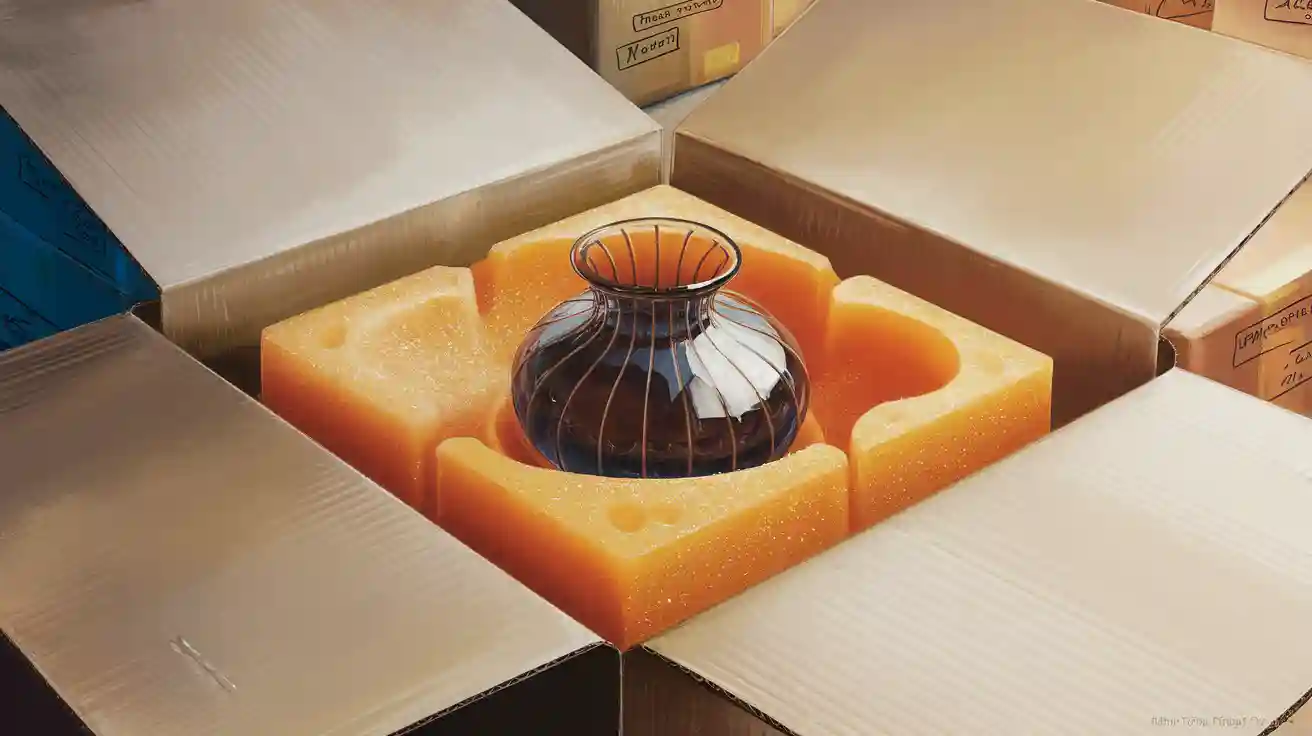
ou face a real challenge in protecting goods during shipping. One in ten packages worldwide arrives damaged, mostly due to poor packaging. Shockproof Silicone Foam gives your products a strong layer of defense. It absorbs shocks, blocks moisture, and keeps fragile items safe. Many returns happen when packaging fails to prevent damage, especially for delicate or high-value products.
| Packaging Failure Type | Impact / Risk | Preventive Measures |
|---|---|---|
| Inadequate packaging | Damaged goods, costly returns, lost trust | Use advanced foam protection |
| Insufficient cushioning | Product breakage, customer frustration | Custom-fit foam inserts |
https://www.rolifyx.com/contact-us
Shockproof Silicone Foam
Material Features
You want packaging that stands up to real-world shipping challenges. Shockproof Silicone Foam gives you that edge. This material is made from 100% environmentally friendly silica gel, combined with a chemical foaming agent. During production, high temperatures create countless tiny, closed cells inside the foam. These closed cells make the foam dense and waterproof, so it resists water absorption and blocks air infiltration. You can count on this foam to keep moisture, dust, and air away from your products.
The closed-cell structure also means you get excellent resistance to compression and vibration. The foam stays flexible in extreme temperatures, from -70°C to 260°C. It does not break down when exposed to harsh chemicals or UV rays. You can use it for products that need fire retardancy and long-lasting durability. The foam's density, ranging from 21 to 43 lbs./ft², gives you strong mechanical and dielectric properties. This makes it ideal for gasketing, cushioning, and insulation in packaging.
Tip: You can customize the thickness and density of Shockproof Silicone Foam to match your product's needs. Higher density foams provide better shock absorption at the same thickness, so you can protect fragile items without adding bulk or weight.
Shock Absorption
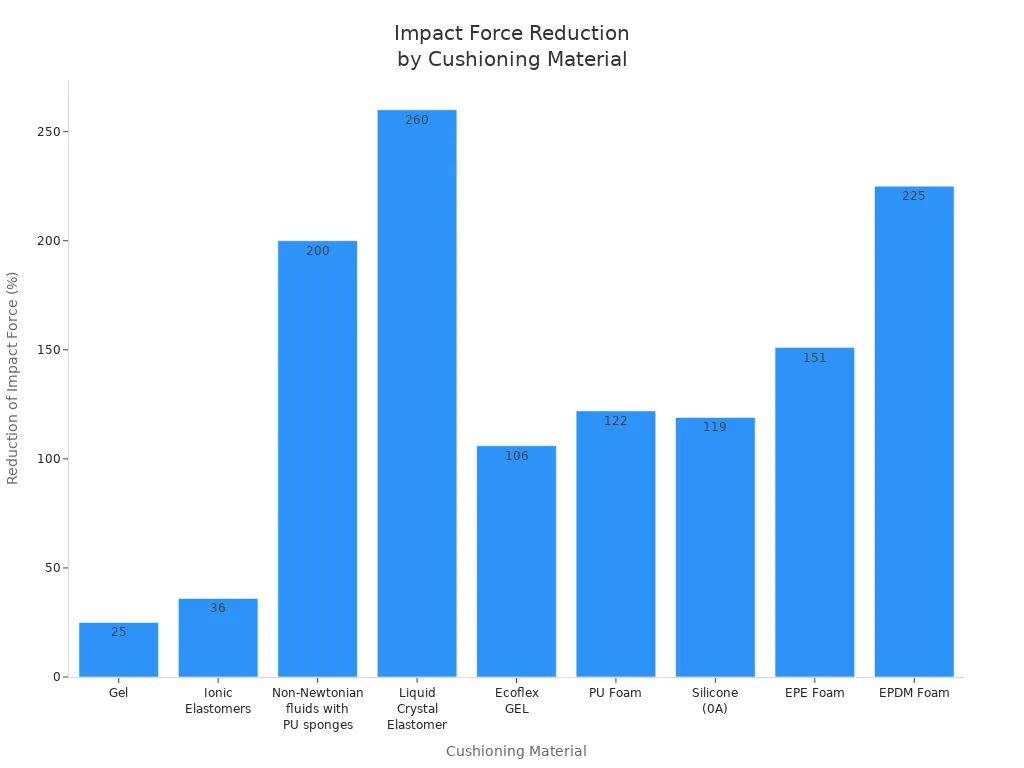
When your package faces drops or bumps, you need reliable shock absorption. Shockproof Silicone Foam cushions your goods by spreading out impact forces. Laboratory tests show that silicone foam reduces impact force significantly compared to many other materials. For example, higher density foams absorb more shock at a given thickness, while lower density foams need to be thicker to offer the same protection. This means you can keep your packaging slim and efficient.
| Cushioning Material | Cushioning Efficiency (%) | Reduction of Impact Force (%) | Control |
|---|---|---|---|
| PU Foam | N/A | 122 | Silicone foam |
| Silicone (0A) | N/A | 119 | Silicone foam |
| EPE Foam | N/A | 151 | Silicone foam |
| EPDM Foam | N/A | 225 | Silicone foam |
| Ecoflex GEL | N/A | 106 | Silicone foam |
You also get protection from moisture and air. The foam's closed cells and elastic structure let it seal tightly around your products. It fills gaps, blocks water and dust, and keeps your items safe even if the package faces rough handling or changing weather. You can trust Shockproof Silicone Foam to maintain its seal and cushioning power throughout the journey.
Benefits
Impact Protection
You need packaging that truly protects your products from drops and shocks. Silicone foam stands out for its ability to absorb and dissipate impact energy. In ball drop tests, researchers dropped a steel sphere from a height of 200 mm onto silicone foam. The foam absorbed the energy, reducing the rebound height and showing strong damping capability. During impact detection tests, the foam's electrical resistance spiked, then stabilized, proving its ability to respond and recover from shocks.
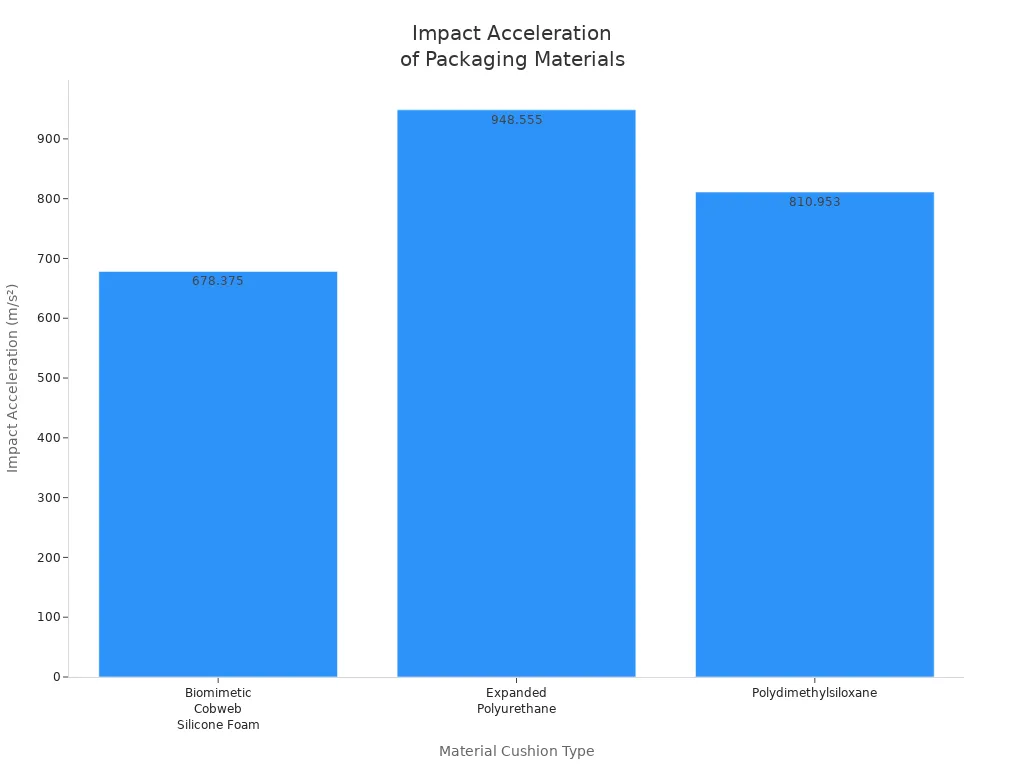
You can see the difference in real-world drop tests. When you use biomimetic cobweb silicone foam, you get the lowest impact acceleration among common packaging materials. For example, at a 700 mm drop height, this foam achieved an impact acceleration of only 678.375 m/s². Expanded polyurethane (EPU) and polydimethylsiloxane (PDMS) showed higher values, meaning less protection for your goods.
| Material Cushion Type | Drop Height (mm) | Impact Acceleration (m/s²) | Performance Compared to No Cushion or Other Materials |
|---|---|---|---|
| Biomimetic Cobweb Silicone Foam (HL-1029) | 700 | 678.375 | Lowest impact acceleration, best cushioning performance |
| Expanded Polyurethane (EPU) | 700 | 948.555 | Higher impact acceleration than HL-1029 |
| Polydimethylsiloxane (PDMS) | 700 | 810.953 | Higher impact acceleration than HL-1029 |
You can rely on silicone foam to reduce damage, fill gaps, and buffer against drops and vibrations. This means fewer damaged goods and lower return rates for your business.
Moisture and Chemical Resistance
You want your packaging to protect against more than just impacts. Silicone foam resists moisture, chemicals, and abrasions. The closed-cell structure blocks water and air, keeping your products dry even in humid or wet conditions. You can ship electronics, glassware, or medical devices with confidence, knowing the foam will not break down when exposed to harsh chemicals or rough handling.
The foam's resistance to abrasions and chemicals also means you get longer-lasting protection. Your packaging will not degrade quickly, so you avoid the costs and risks of damaged goods due to environmental exposure.
Lightweight Design
Shipping costs can add up quickly, especially when you ship large volumes. Silicone foam's lightweight nature helps you save money. By reducing the total weight of your shipments, you lower transportation expenses and improve fuel efficiency. This makes silicone foam an economical and environmentally friendly choice for packaging.
Tip: Lighter packaging not only saves you money but also reduces your carbon footprint. You can protect your goods and support sustainability at the same time.
Custom Fit
Every product has unique packaging needs. Silicone foam offers extensive customization options to fit irregularly shaped items. You can choose from different colors, hardness levels, surfaces, sizes, and even add your logo. Manufacturers can create complex profiles and molded shapes that match your product exactly.
Customization options include:
Colors, hardness, and surface finishes
Sizes and dimensions tailored to your product
Logos and branding
Irregular shaped foam strips and molded profiles
Collaboration with manufacturers to meet specific requirements
Custom-molded silicone foam improves product stability during transportation. The foam's cellular structure allows it to compress and conform to surfaces, creating lasting seals. It absorbs shocks, resists compression-set, and maintains its properties over time. You get consistent cushioning and protection, even after repeated use or exposure to temperature changes.
| Feature/Property | Explanation |
|---|---|
| Cellular Structure | Compresses and conforms to surfaces, creating effective, lasting seals that stabilize products. |
| Shock Absorption | Protects sensitive components from mechanical vibrations and impacts. |
| Compression-Set Resistance | Retains sealing and cushioning properties over time, even after prolonged compression. |
| Thermal Stability | Maintains integrity across a wide temperature range. |
| Resistance to Mechanical Fatigue | Ensures durability under repeated compression and stress. |
| UV and Ozone Resistance | Protects foam from environmental degradation. |
| Custom Molding | Provides precise fit and consistent cushioning tailored to product shapes. |
You can see how Shockproof Silicone Foam adds value by reducing damage, lowering shipping costs, and providing a perfect fit for any product. This level of protection and efficiency helps your business deliver goods safely and reliably.
Applications

You see the value of advanced packaging materials across many industries. Companies in electronics, glassware, ceramics, food, and medical sectors rely on silicone foam to protect products during shipping and storage. This material absorbs shocks and vibrations, reducing breakage rates and costly returns. You also benefit from foam sealing strips that keep out moisture, dust, and contaminants, ensuring your goods arrive in perfect condition.
Electronics
You ship sensitive electronics that require reliable protection. Silicone foam cushions devices like smartphones, tablets, and circuit boards. It absorbs impact from drops and vibrations, which lowers the risk of internal damage. Custom-molded foam inserts hold each item securely, preventing movement inside the box. For example, a shipment of 10,000 smartphones with silicone foam inserts can reduce transit damage rates by up to 80% compared to traditional fillers. This translates to fewer returns and higher customer satisfaction.
Tip: Custom foam profiles can include cutouts for cables, batteries, or accessories, keeping every component in place.
Glassware
You know glassware and ceramics break easily during transit. Silicone foam provides a soft, yet firm, barrier that absorbs shocks and prevents direct contact between items. Foam inserts can be tailored to fit wine glasses, laboratory beakers, or decorative vases. In a logistics study, companies using silicone foam for glassware packaging reported a 70% reduction in breakage compared to standard bubble wrap. You save money on replacements and maintain your reputation for quality.
| Product Type | Breakage Rate with Bubble Wrap (%) | Breakage Rate with Silicone Foam (%) |
|---|---|---|
| Wine Glasses | 12 | 3 |
| Lab Beakers | 9 | 2 |
| Decorative Vases | 15 | 4 |
Medical Devices
You face strict regulations when shipping medical devices. Silicone foam meets key standards for safety and quality. It protects sensitive instruments from shocks, moisture, and contamination. You can sterilize the foam using autoclaving, gamma irradiation, or ethylene oxide. Manufacturers customize foam inserts to fit surgical tools, implants, or diagnostic equipment, reducing movement and risk of damage.
| Regulatory Standard | Description | Relevance to Medical Device Packaging |
|---|---|---|
| 21 CFR Part 177 | FDA safety for polymers in contact with food | Ensures non-toxicity and safety |
| USP Class VI | Biocompatibility and toxicity testing | Confirms safe use in medical settings |
| ISO 10993 | Biological safety evaluation | Validates biological safety |
| ISO 9001/13485 | Quality management standards | Ensures consistent manufacturing |
| ISO 14971 | Risk management for medical devices | Addresses hazard identification |
| FDA 510(k) | Market approval process | Required for new device packaging |
| FDA Master Files | Material safety documentation | Facilitates regulatory review |
You must use biocompatible, sterilizable foam.
Material properties like density and chemical resistance must meet strict requirements.
Working with expert suppliers ensures compliance and product safety.
You gain peace of mind knowing your medical shipments meet global standards and arrive safely.
Comparison
Traditional Materials
When you choose packaging, you often see options like bubble wrap, expanded polystyrene (EPS) foam, and basic polyurethane foams. These materials have served the industry for decades, but they come with limitations. Bubble wrap cushions light impacts, but it loses air and protection over time. EPS foam offers some shock absorption, but its large, uneven cells can break under repeated stress. You may notice that these traditional materials struggle with moisture, temperature changes, and chemical exposure.
Let's look at how silicone foam stands out:
Silicone foam features a dense, closed-cell structure with cell sizes as small as 4 μm, compared to the larger, less uniform cells in EPS or bubble wrap.
The foam/solid multilayered design increases compressive strength by over 237% compared to pure foam, giving you better resistance to crushing forces.
Silicone foam maintains elasticity and cushioning even after repeated impacts, while traditional foams often lose shape and effectiveness.
You benefit from high resistance to water, aging, and extreme temperatures, which traditional materials cannot match.
Performance
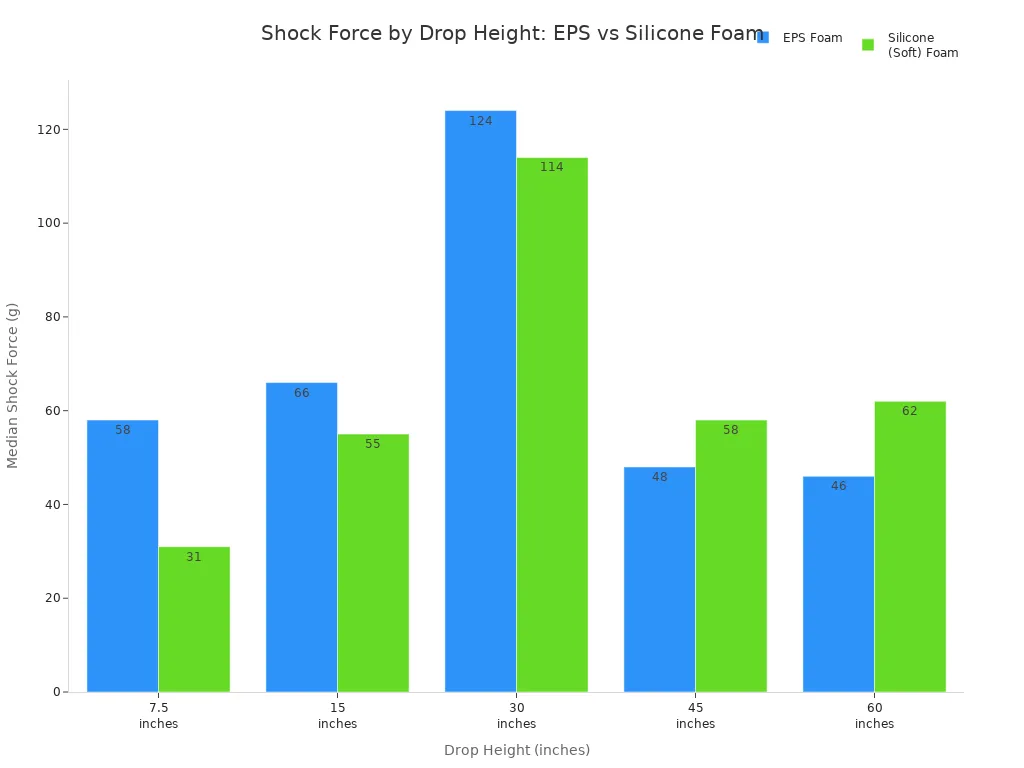
You want to know how these materials perform in real-world drop tests. Standardized tests show clear differences in shock absorption. The table below compares median shock forces for EPS foam and silicone foam at various drop heights:
| Drop Height (inches) | Median Shock Force with EPS Foam (g) | Median Shock Force with Silicone (Soft) Foam (g) | Statistical Significance (p-value) |
|---|---|---|---|
| 7.5 | 58 | 31 | < 0.001 |
| 15 | 66 | 55 | < 0.001 |
| 30 | 124 | 114 | 0.98 |
| 45 | 48 | 58 | 0.64 |
| 60 | 46 | 62 | 0.11 |
You see that silicone foam reduces shock force by about 10 g at lower drop heights, which means better protection for fragile goods. At 7.5 inches, silicone foam cuts the shock force nearly in half compared to EPS. This difference can prevent costly damage during short drops or handling.
When you use advanced foam, you deliver products with fewer damages and higher customer satisfaction. Reliable cushioning means fewer returns and a stronger reputation for your business.
Implementation
Selection Tips
You want to choose the right silicone foam for your packaging needs. Start by considering the specific requirements of your products and shipping environment. The table below helps you compare important criteria:
| Criteria Category | Considerations and Details |
|---|---|
| Application Area & Thickness | Assess space constraints and required material thickness for the packaging application. |
| Sealing Efficiency | Evaluate foam compression needed for a positive seal, considering compression deflection and set. |
| Mechanical Resilience | Consider resistance to fatigue, impact, elongation, and tensile strength based on packaging demands. |
| Color | Choose foam color based on aesthetic requirements of the packaging. |
| Compliance Standards | Ensure foam meets relevant UL, FR, MIL, automotive, or FDA standards applicable to packaging. |
| Environmental Exposure | Account for humidity, ozone, UV radiation, temperature extremes, chemicals, solvents, and fuels exposure. |
| Insulation Properties | Consider thermal, electrical, acoustical, or vibration insulation needs in packaging. |
| Expected Lifespan | Evaluate durability and longevity requirements for the packaging foam. |
| Material Strengths | Silicone foam offers thermal stability, flexibility across extreme temperatures, inertness, non-toxicity, excellent resistance to compression set, UV, ozone, weathering, solvents, and flame retardancy. Suitable for high-temperature, food-grade, and medical packaging. |
| Material Limitations | Higher cost and lower tear strength compared to alternatives. |
Tip: You can reduce damage rates by up to 80% in electronics shipments when you match foam density and thickness to your product's fragility.
Common challenges in foam selection include shrinkage from incorrect catalyst ratios, core scorching due to poor temperature control, and density variation from uneven mixing. Surface imperfections like cracks and streaks often result from rapid expansion. You must calibrate machines regularly and maintain strict quality controls to avoid these issues. Contamination by fibers and particulates can increase reject rates above 10%, so advanced particle identification methods help maintain consistent quality.
Integration
You want to integrate silicone foam into your packaging and logistics processes efficiently. Follow these steps:
1.Identify your packaging requirements for each product type. For example, use anti-static bags with desiccants for electronics or sterile barrier systems for medical devices.
2.Select tailored packaging solutions that protect against environmental risks such as UV degradation or moisture.
3.Check compliance with regional regulations. For US shipments, use child-resistant packaging. For EU imports, prepare REACH documentation.
4.Build partnerships with global logistics providers to support regulatory compliance and efficient distribution.
5.Set up real-time shipment tracking to monitor progress and respond quickly to delays or damage.
6.Use bonded warehouses for just-in-time delivery, especially in automotive supply chains.
Note: Companies that implement real-time tracking and bonded warehouse options report up to 25% faster delivery times and lower inventory costs.
You can maximize the value of Shockproof Silicone Foam by following these steps. Proper selection and integration help you reduce damage rates, improve customer satisfaction, and streamline your supply chain.
You gain real value when you choose Shockproof Silicone Foam for packaging and transportation. This material delivers strong shock and vibration protection, high resilience, and reliable performance in harsh environments. You also benefit from cost
savings and fewer damaged goods. Review the key factors below before making your decision:
| Factor Category | Key Considerations |
|---|---|
| Shock and Vibration | Product protection from impact and movement |
| Cost Factors | Material and labor costs, productivity |
| Environmental Concerns | Recycling, environmental impact |
| Cleanliness | Avoidance of dust and contamination |
You improve customer satisfaction and reduce returns by optimizing your packaging with advanced foam solutions.
FAQ
What makes shockproof silicone foam better than traditional packaging materials?
You get up to 80% fewer damaged electronics when you use silicone foam instead of bubble wrap. The closed-cell structure absorbs shocks and blocks moisture. This means you reduce returns and save money on replacements.
How does silicone foam help lower shipping costs?
You benefit from lightweight foam that reduces package weight by up to 30% compared to EPS. Lower weight means you pay less for shipping. You also avoid extra costs from damaged goods and customer returns.
Can you use silicone foam for temperature-sensitive shipments?
Yes. Silicone foam stays flexible from -70°C to 260°C. You protect products like medical devices or electronics during extreme temperature changes. This stability helps you maintain product quality throughout the supply chain.
Is silicone foam packaging customizable for different products?
You can order foam inserts tailored to your product's shape, size, and fragility. Custom molding reduces movement inside the box. For example, glassware breakage drops from 12% to 3% with custom silicone foam inserts.
What industries see the most value from silicone foam packaging?
Electronics, glassware, and medical device industries report the highest reduction in damage rates. For instance, medical shipments using silicone foam meet FDA and ISO standards, ensuring safe delivery and regulatory compliance.
Note: All data and statistics referenced in this FAQ come from industry studies and packaging performance reports.