

Flame retardant silicone foamFlame retardant silicone foam is very important for fire safety in the future. It meets new safety rules for next-generation buildings. Its special design can handle very high heat, even up to 1300 °C. It makes a strong ceramic wall when there is a fire. The table below shows special science features that make it better than old fireproof materials:
| Scientific Property | Benefit in 2025 Safety |
|---|---|
| Ceramifiable conversion | Forms protective barrier, stops flames |
| Nanomaterial integration | Enables rapid fire-warning |
| Low smoke and toxicity | Increases safety for people |
These new ideas help solve fire safety problems in important places.
Fire Safety in 2025
New Industry Demands
In 2025, new fire safety rules are changing how companies use fireproofing. Many industries like construction, cars, electronics, aerospace, and renewable energy need better fire-resistant and eco-friendly materials. Groups in the European Union and North America made the rules stricter. Now, companies must follow EN 13501 and NFPA codes. Projects around the world also need IEC and FM certifications. These changes are because cities are growing fast and buildings are more complex. People also want safer places to live and work.
If companies do not follow fire safety rules, they can get big fines or lose money. So, following the rules is very important for businesses.
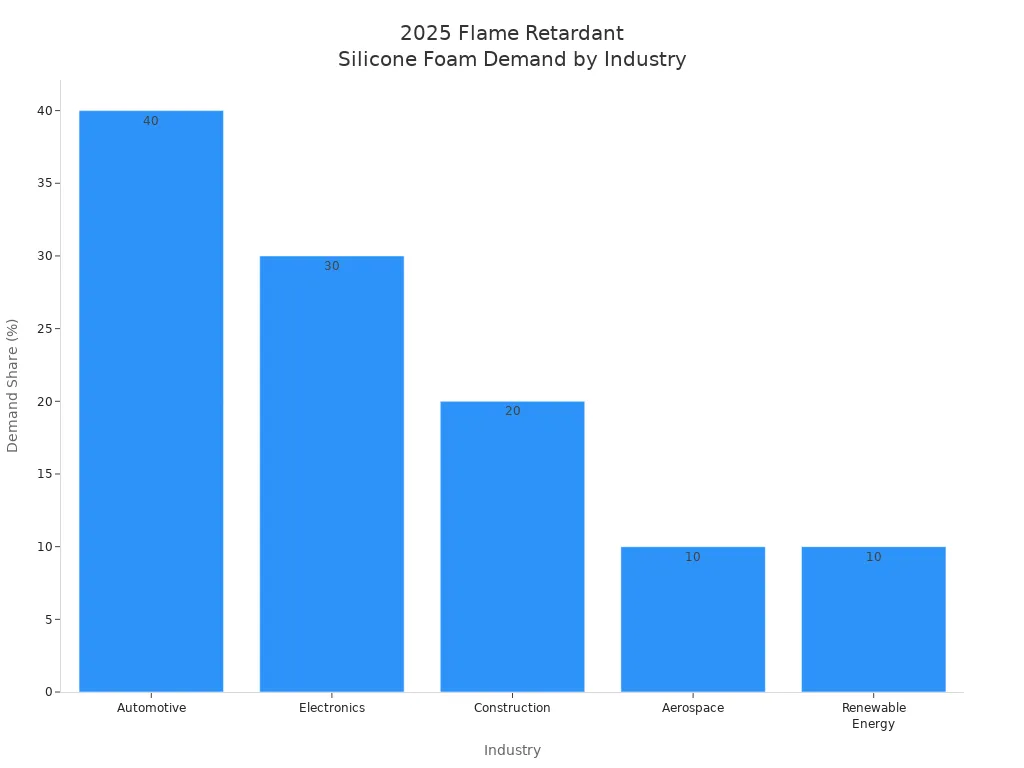
More companies want flame retardant silicone foam for their products. The table below shows which industries will use it most in 2025:
| Industry | Demand Share (2025) | Key Drivers |
|---|---|---|
| Automotive | ~40% | Safety rules, lighter cars, more electric vehicles, need for insulation |
| Electronics | ~30% | Data center safety, 5G, smaller devices, heat control |
| Construction | ~20% | Rules, tall building safety, certified fireproof materials |
| Aerospace | Emerging (~10%) | Insulation, fire barriers, safety and performance needs |
| Renewable Energy | Emerging (~10%) | Solar panels, wind turbines, environmental and safety rules |
Companies also want fireproof materials that are safe for the environment. They need to update old buildings and build more warehouses. This makes the need for better fire barriers even bigger.
Material Limitations
Old fireproof materials cannot meet the new 2025 rules. Many old materials let heat pass through, which is dangerous in a fire. Polymers and rubbers can burn fast and make toxic smoke, which is unsafe for people. Halogenated flame retardants are being banned because they are harmful when burned. Inorganic nanoparticles help with fire resistance but can make materials weaker and harder to use.
Old silicone rubber foam turns into carbon, so it does not protect well.
Adding inorganic fillers makes the foam weaker and less able to expand.
Regular materials cannot make a ceramic barrier, which is needed to stop fire from spreading.
Flame retardant silicone foam fixes these problems by making a ceramic layer when it burns. This layer helps stop flames, keeps the material strong, and holds its shape. Because of this, companies can follow strict fire safety rules and keep people and property safer. The market for flame retardant silicone foam is growing fast, with more than 6% growth expected until 2032.
Science of Flame Retardant Silicone Foam
Chemical Structure
The special chemical structure of flame retardant silicone foam makes it different from older fireproof materials. Scientists discovered that Si–O and Si–C bonds in the foam are very important for fire resistance. When the foam gets very hot, these bonds help make a burned layer on top. This burned layer is strong and keeps heat and flames away from the inside. Making this barrier helps the foam stop fire better.
Fire safety in the future needs materials that can handle tough situations. The chemical structure of flame retardant silicone foam helps it stay strong and work well, even as fire safety rules get harder.
A table comparing bond strength and fire resistance:
| Bond Type | Energy (kJ/mol) | Fire Resistance Contribution |
|---|---|---|
| Si–O | ~460 | High thermal stability |
| Si–C | ~360 | Char layer formation |
| C–C (typical polymer) | ~350 | Lower thermal stability |
This table shows why silicone-based materials work better than many old polymers during fires.
Additives and Mechanisms
Additives are very important for making silicone foam more fire-resistant. The best flame retardant additives are silicone resin flame retardants and polysiloxane flame retardants. These additives keep their strength in heat, do not break down easily, and stay flexible. When there is a fire, they make a cracked carbon layer and an inorganic oxygen insulation layer on the foam. This layer, full of Si and Si–C bonds, blocks heat and air, stopping the fire from burning more.
Here is how these additives work:
Endothermic reactions: Take in heat and cool down the material.
Covering effects: Make a strong foam layer that keeps air away.
Free radical capture: Trap active particles and make flames weaker.
Release of non-combustible gases: Mix with flammable gases and make it harder for fire to grow.
A closer look at halogen-based and intumescent additives:
| Additive Type | Mechanism (Phase) | How It Works | Environmental Impact |
|---|---|---|---|
| Halogen-based | Gas phase | Releases halogen radicals that stop combustion chain reactions | High toxicity, being phased out |
| Intumescent | Condensed phase | Forms a dense, expanded char layer that insulates and blocks heat/oxygen | Low toxicity, eco-friendly |
As fire safety rules get stricter, companies are choosing intumescent and silicone-based additives for safer and greener fire protection.
Ceramifiable and Intumescent Features
Ceramifiable and intumescent properties make flame retardant silicone foam a great choice for fire safety in the future. When there is a fire, ceramifiable silicone foam makes a hard ceramic layer. This layer makes the foam stronger and keeps it safe in high heat. Intumescent features help the foam grow bigger, making a thick burned layer that protects the inside from more damage.
A chart shows how well the foam works after a fire:
Ceramifiable foam: Keeps more than 80% of its strength after fire
Traditional foam: Drops below 20% of its strength after fire
Lab tests prove these benefits. Scientists found that ceramifiable silicone rubber makes strong ceramic layers, which help stop fire and keep the foam stable in heat. Intumescent systems, like those using hexophenoxy cyclotriphosphazene and ammonium polyphosphate, make fire resistance much better. Real-life tests on coated polyurethane foam show that it puts out fire quickly and stays strong during a fire.
Ceramifiable and intumescent features work together so flame retardant silicone foam can resist fire and keep its shape and use, even in tough places.
Fire safety rules keep changing. Tests like cone calorimetry and standards such as KS F 4910:2023 and ISO 11600:1993 help check how well silicone-based fireproof materials work. These tests look at heat, flame spread, and strength, making sure flame retardant silicone foam meets the highest safety needs for the future.
Flame Retardant Silicone Foam vs. Other Materials
Heat Resistance
Flame retardant silicone foam is good at handling heat and fire. Solid silicone rubber can work in very cold and hot places, from -60°C to 250°C. It meets tough safety rules like UL 94 V-0. Silicone foam does not resist as much heat, but it is still useful for many fire safety jobs. Fiberglass and mineral wool can take even higher heat. But their glue can burn, and they are not as bendy as silicone foam.
| Material Type | Max Temperature Resistance | Flame Retardancy Level |
|---|---|---|
| Solid Silicone | -60°C to 250°C | UL 94 V-0 (highest) |
| Flame Retardant Silicone Foam | Up to 300°F (~150°C) | Basic to moderate |
| Fiberglass | Up to 1,000°F (~540°C) | Non-flammable (glass only) |
| Mineral Wool | Up to 1,220°F (~660°C) | Noncombustible |
In the future, companies will pick materials for both fire safety and how well they work. Flame retardant silicone foam is safe and flexible. This makes it a good choice for new fire barriers.
Durability
Durability is why many companies use silicone foam for fireproofing. Flame retardant silicone foam stays bendy and strong for a long time. It does not break down in sunlight or get old fast. Polyurethane foam costs less but wears out quickly outside. It needs to be replaced often. Silicone foam does not crack and works well in tough places. This means less fixing and lower costs over time.
🚗 Car and electronics makers use silicone foam for seals and battery covers. It helps absorb bumps and shakes and works in hot and cold.
🏢 In building, silicone foam lasts longer. This means fewer replacements and saves money, even if it costs more at first.
Environmental Impact
New rules are changing what fireproof materials companies can use. Many old flame retardants, like halogenated ones, are being banned because they are bad for health and the planet. Flame retardant silicone foam uses safer choices, like nitrogen-based and metal hydrate additives. These follow new EPA and CPSC rules. Using these helps keep people and nature safe.
| Additive Type | Environmental Profile | Regulatory Trend |
|---|---|---|
| Halogenated | High toxicity, persistent | Being phased out |
| Nitrogen-based | Low toxicity, safer | Preferred for the future |
| Metal hydrates | Eco-friendly | Increasingly adopted |
As the world wants greener products, flame retardant silicone foam will help meet fire safety and protect the environment.
Trends and Innovations
Technology Advances
New technology is changing how companies use flame retardant silicone foam. Scientists have found better ways to stop fires and keep foam strong. 1.They use new flame retardants and fillers to help the foam last longer.
2.Companies now pick halogen-free flame retardants to help the planet.
3.Phosphorus-nitrogen flame retardants make foam safer in fires and keep it strong.
4.Inorganic fillers like magnesium hydroxide and graphene nanoplatelets make foam safer and cost less.
5.Nano-flame retardants with special coatings mix better in foam, so it stays tough.
6.Functional nanofillers like boron nitride, MXene, and ceramic powders give foam new features like heat control and blocking signals.
7.Polyhedral oligomeric silsesquioxanes help foam make a ceramic layer when it burns.
8.Intumescent systems with expanded graphite and special melamine polyphosphate help foam fight fire, water, and damage.
| Technology Advance | Benefit |
|---|---|
| Halogen-free flame retardants | Safer for people and nature |
| P-N flame retardants | Better fire resistance |
| Nano-flame retardants | Stronger, more flexible foam |
| Functional nanofillers | Extra features (heat, shielding) |
| Intumescent systems | Improved fire and water safety |
These new ideas help companies make foam that is safer, stronger, and better for the earth.
Future Applications
In the future, more industries will use flame retardant silicone foam. Companies want materials that are light, safe, and easy to shape. New rules and products push this change.
1.Electric car battery packs need safe, fire-resistant foam. The car industry uses about 40% of all flame retardant silicone foam.
2.Aerospace companies use foam for seats and walls. They need light and strong materials for safety.
3.Electronics makers use foam for insulation and padding. This is about 20% of the market.
4.Smart foams with sensors will help watch safety in real time.
5.Additive manufacturing lets companies make special foam shapes for different uses.
6.More companies want halogen-free and eco-friendly foam to follow new laws.
| Sector | Market Share (2025) | Key Application |
|---|---|---|
| Automotive | 40% | Battery packs, insulation |
| Aerospace | 25% | Interiors, lightweight barriers |
| Electronics | 20% | Insulation, cushioning |
| Smart Devices | Growing | Sensor-embedded safety foams |
Companies have challenges as they try to make better foam. They must keep foam strong while adding new fire-resistant features. Making the process faster and easier will help more industries use this material.
Flame retardant silicone foam is very important for fire safety in the future. Experts think it will be used more because it can handle heat well and makes less smoke. It also meets tough safety rules around the world. Fire safety groups say silicone-based materials are good for important buildings. These materials can put out their own flames and make less harmful smoke.
| Application Area | Key Benefit | Standard Met |
|---|---|---|
| Electric Vehicles | Battery fire containment | UL-94, EN45545-2 |
| Mass Transit | Low smoke, high durability | EN45545-2 |
| Aerospace | Lightweight, self-extinguish | FAR/JAR 25.823 |
Experts say smart sensors and safe additives are being added.
Real-life tests show better fire safety and longer-lasting foam.
Companies that want better fire protection should use flame retardant silicone foam. It is safer, better for the environment, and more dependable for 2025 and later.
FAQ
Why will flame retardant silicone foam become more important in 2025?
Flame retardant silicone foam will help meet new safety rules. Companies want materials that can take more heat and make less toxic smoke. The market for this foam is growing fast. It is expected to grow about 6% each year until 2032.
| Year | Market Growth (%) |
|---|---|
| 2025 | 6.0 |
| 2028 | 6.2 |
| 2032 | 6.5 |
What makes silicone foam safer than traditional fireproof materials?
Silicone foam makes a ceramic wall when there is a fire. This wall keeps out heat and flames. Tests show ceramifiable silicone foam stays strong after fire. It keeps over 80% of its strength. Regular foam loses most of its strength and drops below 20%.
Tip: Use ceramifiable foam in places where safety matters most.
Which industries will benefit most from advanced silicone foam?
Car, electronics, and airplane companies will get the most help. Electric cars and smart gadgets need light and fire-safe materials. The table shows how much each industry will use in 2025.
| Industry | Demand Share (%) |
|---|---|
| Automotive | 40 |
| Electronics | 30 |
| Aerospace | 25 |
How does flame retardant silicone foam support environmental goals?
Makers use halogen-free and nitrogen-based additives in the foam. These choices make the foam safer for people and the planet. They also follow new EPA rules. More than 70% of new products will use eco-friendly flame retardants by 2025.
What future innovations will improve silicone foam performance?
Scientists are making smart foams with sensors and new nanofillers. These changes help the foam fight fire better and watch for danger in real time. Companies think these new features will make more people use silicone foam in electric cars and smart buildings.
| Innovation | Expected Impact |
|---|---|
| Smart sensors | Real-time alerts |
| Nanofillers | Higher durability |
| Intumescent agents | Better fire safety |